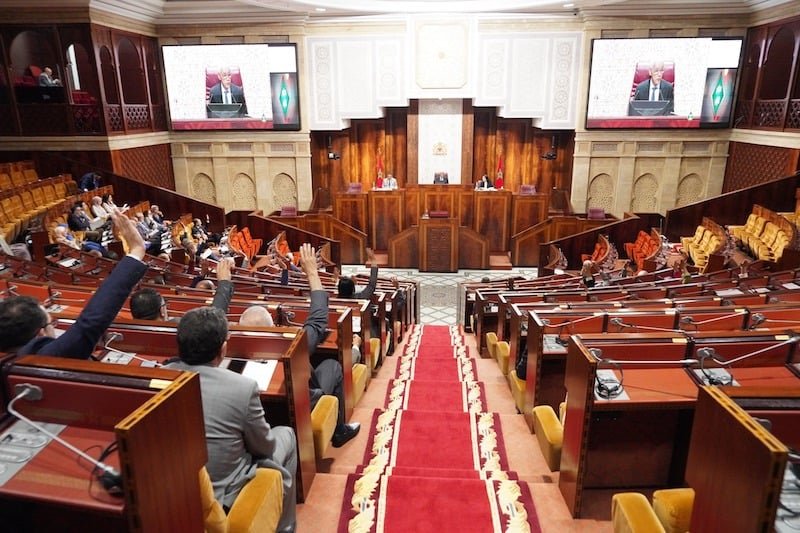
Study: The rise in verbal questions in the House of Representatives was not accompanied by the development of control mechanisms over the government
According to what was published by Lakm website, a study by the Moroccan Institute for Policy Analysis confirmed that the remarkable increase in the number of oral questions in the House of Representatives was not accompanied by a similar development in the methods of managing, monitoring and tracking supervisory activity, including...
Listen to the article
AI-generated narration
According to what was published by the "Lakm" website, a study by the Moroccan Institute for Policy Analysis confirmed that the remarkable increase in the number of oral questions in the House of Representatives was not accompanied by a similar development in the methods of managing, monitoring and tracking oversight activity, in order to ensure clarity of participation and balance of oversight guidance between government sectors.
The study was completed by journalist Yasser Al-Makhtoum, and dealt with the outcome of the oral questioning sessions during the legislative mandate 2021-2026. It showed that oversight activity expanded compared to the previous mandate, with the total of interventions increasing from 7,124 to 10,354. The number of verbal questions increased by 61 per cent, but this quantitative expansion was not matched by qualitative progress in control mechanisms.
The study was based on an analysis of 125 weekly sessions, and recorded three main gaps. The first relates to the uneven distribution of participation among deputies, and the second to the concentration of 29 per cent of sectoral interventions in four sectors. The third relates to tracking government undertakings, as only 40 percent of the 1,339 undertakings listed in the tracking rule were available.
According to the study, The four most present sectors accounted for 2,812 interventions, namely, equipment and water with 798 interventions, agriculture and rural development with 704 interventions, civic education, primary education and sports with 677 interventions, and health and social protection with 633 interventions. In contrast, other sectors registered a limited presence, between 51 and 192 interventions each.
The study indicated that 41 deputies, representing 10.4 per cent of the 395 members of the Council, did not record any intervention in the weekly sessions during the period covered. She added that 23 of them are running again in the ballot of September 23, 2026, while ten deputies accounted for about 10 percent of the total interventions.
The study concluded that the high number of interventions alone is not sufficient to assess parliamentary performance, and that there is a need for more systematic and transparent data on the distribution of participation and the use of tools, and for more complete mechanisms to track the outcome of pledges and verify their implementation.
Source: Lakm - https://lakome2.com/politique/437141/
Share
Scan the code to open the article in WeChat
💬 Comments (0)
Join the Conversation
Comments are reserved for registered members. Create your free account to join and interact with BusinessPress+
Free — no payment required
Be the first to comment